

Helium-3 is a rare, non-radioactive isotope found in the Moon’s surface material that has significant potential applications, including in quantum computing and, potentially, nuclear fusion energy. While helium-3 is extremely scarce on Earth, the Moon is believed to contain substantially greater quantities, accumulated in its surface regolith over billions of years through exposure to the solar wind. This relative abundance has made lunar helium-3 an increasingly attractive potential space resource. Global demand for helium-3 is projected to increase nearly fourteenfold between 2025 and 2035. In response to this growing interest, several companies are exploring technologies for extracting helium-3 from the lunar surface, including robotic systems designed to process lunar regolith, capture the gas, and eventually transport it back to Earth.
Several legal issues arise, however, as the prospect of extracting helium-3 from the Moon moves from scientific possibility toward commercial reality. I will explore some of these issues in a series of blog posts, beginning with this one.
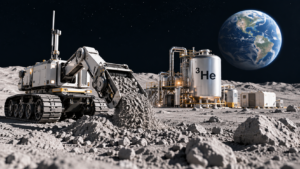
Part I: Insurance
How could insurance address the unique risks of a lunar helium-3 mining operation (including loss or damage to equipment, valuation of an untested commercial operation, injury or death of personnel, and the transportation of helium-3 from the Moon to Earth) and are existing space insurance products adequate, or would new forms of coverage be required?
How would a company insure mining equipment on the Moon?
Insuring lunar mining equipment would require first-party property coverage, presenting a different set of challenges from the third-party liability insurance traditionally associated with the commercial space sector. Property insurance ordinarily depends on reasonably predictable loss data and, often, the possibility of inspection, repair, recovery, or salvage. All of that becomes much more difficult when the equipment is operating on the lunar surface.
One possible solution could be a public-private risk-sharing arrangement, in which private insurers cover an initial layer of loss and the government assumes or reinsures losses above an agreed threshold, subject to a cap and perhaps a coinsurance requirement. Whether the government would be willing to assume that role is, of course, another question. Public support for covering losses involving privately owned lunar equipment is uncertain though.
If that were the route, the existing U.S. commercial launch regime could provide a useful precedent for the broader concept of government participation in extraordinary space risks, although it is important to distinguish the two. The launch regime addresses third-party liability, not first-party loss of an operator’s own equipment. Under that regime, private operators must demonstrate financial responsibility for specified third-party liability arising from licensed launch and reentry activities, while the federal government may assume certain excess third-party claims above the required private layer.
A comparable program for lunar equipment would therefore likely require new statutory authority specifically addressing first-party property losses. We would have to deal with difficult questions of valuation, covered risks, deductibles, verification of losses, salvage rights, and the allocation of catastrophic losses among the operator, private insurers, and the government.
Is the existing space insurance market equipped to cover long-term lunar mining operations?
Probably not. The existing market has experience with launch and satellite risks, where insurers have decades of data concerning launch failures, satellite performance, and particular technologies. A long-term lunar mining operation would present a very different risk profile. Insurers would have much less historical data on issues such as degradation from lunar dust, radiation exposure, extreme thermal cycling, and the performance of equipment operating continuously on the lunar surface.
Also, how to value a loss of a piece of equipment would be difficult: repair, replacement, or recovery may be extremely expensive or impractical. And the economic loss may extend well beyond the value of the equipment itself if its failure interrupts an entire mining operation.
These risks are difficult to price and underwrite with the information currently available. Insurers might respond through bespoke policies, high deductibles, coverage limits, exclusions, or risk-sharing among multiple insurers and reinsurers.
As lunar operations develop and insurers accumulate more operating and loss data, the market may become better able to price these risks. In the early stages, however, insurance is likely to be expensive, limited, and highly customized.
How would an insurer value a lunar helium-3 mining operation without a comparable market?
With significant difficulty, particularly in the early stages, because there is no established market providing comparable values.
There are really two different valuation questions. The first is the value of the physical equipment: Insurers could look at development and replacement costs (even though those figures would be difficult to establish because the equipment is highly specialized and replacing difficult).
The second, and more difficult question, is the value of the operations themselves. Here, existing supply agreements could provide some evidence. For example, Interlune has announced a reported $300 million agreement with Bluefors for the future supply of helium-3, as well as agreements with Maybell Quantum and the U.S. Department of Energy. Those agreements provide useful valuation data points, but they are negotiated contracts between particular parties, not market prices.
So, at least initially, valuation would probably have to rely on a combination of contract values, projected cash flows, replacement costs, and scenario-based loss modeling, rather than traditional actuarial data. And of course, there is also a legal dimension. The United States recognizes rights in space resources, but questions remain internationally about the precise scope of rights associated with extracting and commercializing space resources That legal uncertainty could itself become another factor that insurers would have to consider.
What are the legal consequences if someone is injured or killed on the Moon while engaged in resource extraction activities?
This is a difficult issue, but it is important to keep this issue in perspective: at least initially, lunar mining operations are likely to be largely robotic, with limited human presence on the surface. These questions may become more significant as a more permanent lunar human workforce develops.
At that point, the problem is not necessarily that there is a complete legal vacuum. It is the lack of a clear framework for people working on the lunar surface.
For a U.S. employee injured on the Moon, the first question would be what law applies, which depends on factors such as where the employment relationship is based, where the employee was hired, the employer’s location, the terms of the employment relationship, and the extraterritorial reach of the relevant workers’ compensation statute.
In fact, there are also federal workers’ compensation regimes that apply outside the territorial United States. The Defense Base Act, for example, extends workers’ compensation protection to certain employees working abroad under U.S. government contracts. But those statutes were designed for terrestrial employment.
Also, beyond workers’ compensation, the issue could be liability to other people. If one company’s employee or equipment injures an employee of another lunar operator, questions of tort liability, applicable law, contractual cross-waivers, and insurance coverage would arise.
Congress may ultimately need to clarify which workers’ compensation and liability rules apply.
When does responsibility for insuring helium-3 shift along the supply chain?
This would largely be a matter of contract. The parties would need to decide who bears the risk at each stage, from extraction on the lunar surface, to storage, to transportation from the Moon, and ultimately to delivery on Earth.
While an international treaty exists (the Liability Convention), it does not really answer that question, as it deals with liability for damage caused by space objects; it does not allocate commercial risk of loss among operators/
Therefore helium-3 contracts would have to be very clear about when risk of loss passes and who is responsible for obtaining insurance at each stage. For example, does the mining company bear the risk until the helium-3 is loaded onto a transport vehicle? Does the transporter assume it during transit? Or does the buyer take the risk at an earlier point?
We deal with similar questions in international trade, for example through the Incoterms, which identify when risk passes from seller to buyer. But for lunar resource transactions do not yet have the same body of established commercial practice. The parties could use Incoterms as part of their contractual risk allocation, but existing Incoterms would need to be carefully adapted or supplemented for lunar operations.
So, particularly in the early stages, careful contractual drafting will be extremely important: who bears the risk, at what point does that risk transfer, and who has to insure it?