

Data centers have become so controversial that opposition to their expansion may have influenced the outcome of the November 2026 U.S. midterm elections.
In Texas, Democrat Gina Hinojosa defeated incumbent Governor Greg Abbott in the gubernatorial race after campaigning, among other issues, for a broad, statewide moratorium on new data-center approvals.[1] Texas accounts for approximately 25% of planned U.S. data-center capacity, making the election particularly consequential for the industry. [2]The controversy reflects growing public concerns
over electricity consumption, water use, environmental impacts, and rising utility costs.
The issue has become so prominent that Elon Musk reportedly commented after the election: “Data centers in space looking pretty appealing right now.”[3]
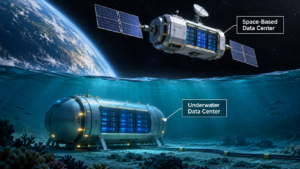
As demand for computing infrastructure continues to accelerate (particularly with the expansion of artificial intelligence) and if terrestrial data centers face this increasing political opposition and regulatory constraints, could the solution be to move them into outer space or beneath the ocean?
Each alternative offers potential advantages, but also substantial technological, economic, environmental, and legal challenges.
- Space-Based Data Centers: Opportunities and Limitations
Space-based data centers envision placing computing, AI processing, and data-storage infrastructure aboard satellites or on the Moon.
Several projects are exploring these possibilities. Google’s Project Suncatcher proposes orbital AI computing infrastructure powered by solar energy. Lonestar Data Holdings has already tested lunar data-storage technology and is developing additional space-based capabilities. See Francesca Giannoni-Crystal, Will In-Space Data Centers Take Privacy Laws Beyond Earth?, Wash. Law., Sept./Oct. 2026, at 14.
Space-based data centers offer several potential advantages over traditional terrestrial facilities.
First, abundant solar energy. Solar-powered orbital infrastructure reduce dependence on terrestrial electricity grids. Depending on orbital configuration, satellites could benefit from extended periods of sunlight, potentially providing a more continuous source of solar power than terrestrial installations.
Second, potentially reduced cooling requirements. Space-based infrastructure avoids some of the energy-intensive cooling systems used by terrestrial data centers, as well as their associated freshwater consumption.
Third, minimal land occupation. Moving computing infrastructure into orbit would substantially reduce the need for large terrestrial facilities. Although space-based systems would still require ground infrastructure, including communications stations, network connections, and operational facilities, their terrestrial footprint would be significantly smaller than that of conventional data centers.
Fourth, resilience and scalability. Space-based facilities could be less vulnerable to certain terrestrial disruptions, including floods, earthquakes, and regional power failures. Moreover, modular satellite architectures could allow computing capacity to expand incrementally through the deployment of additional satellites or computing modules.
There are disadvantages, however.
First, launch remains expensive. Second, replacing or repairing malfunctioning equipment is considerably more difficult than servicing a terrestrial facility.
Third, space also presents risks from radiation, micrometeoroids, and orbital debris. Fourth, although space is cold, the vacuum does not permit conventional convective cooling, so heat generated by computing equipment must be dissipated through radiation, requiring specialized thermal-management systems.
Fifth, communications latency may also constrain applications. For example, signals between Earth and the Moon take approximately 1.3 seconds to travel in one direction, making lunar facilities less suitable for latency-sensitive processing.
Finally, space-based infrastructure raises additional cybersecurity concerns, particularly regarding ground stations, satellite communications, command systems, and remote access.
- Underwater Data Centers: advantages and disadvantages
Underwater data centers use sealed, pressure-resistant modules containing servers and supporting equipment, connected to terrestrial networks through submarine cables.
Underwater data centers have already entered commercial operation in certain locations. In China, an underwater computing facility near Lingshui, Hainan Island, began operations in 2023 and subsequently expanded. A module installed in 2025 reportedly accommodates more than 400 high-performance servers. Another project, Shanghai Lingang, began its demonstration phase in May 2026, with an initial capacity of approximately 2.3 megawatts and plans for expansion to 24 megawatts. The project integrates seawater cooling with offshore wind power.
The principal benefit of underwater data centers is cooling efficiency. Seawater can absorb heat generated by computing equipment, potentially reducing the electricity required for cooling and decreasing freshwater consumption.
Underwater facilities also avoid occupying valuable terrestrial land and can be located near offshore renewable-energy installations. Also, underwater systems benefit from established marine engineering capabilities.
Underwater infrastructure nevertheless presents significant difficulties. Seawater corrosion, hydrostatic pressure, and limited physical accessibility complicate maintenance and repairs. Also, submarine power and communications cables are potential points of failure, vulnerable to accidental damage, sabotage, and cyberattacks.
Environmental concerns must also be considered, including seabed disturbance, thermal discharge, impacts on marine ecosystems, and the challenges of eventual retrieval and decommissioning. Although underwater data centers are, at the moment, more commercially developed than orbital alternatives, their long-term economic advantages over in-space data centers remain uncertain.
- Comparing Space-Based and Underwater Data Centers
| Factor | Space-based data centers | Underwater data centers |
| Energy | Potentially abundant solar energy | Grid electricity and possible offshore renewable integration |
| Cooling | Specialized radiative systems | Seawater-assisted cooling |
| Land occupation | Minimal | Minimal |
| Freshwater consumption | Potentially reduced | Potentially substantially reduced |
| Maintenance | Requires specialized space operations | Requires marine operations |
| Principal risks | Radiation, orbital debris, launch and repair costs | Corrosion, pressure, cable damage |
| Environmental issues | Launch emissions, orbital debris, disposal | Marine ecosystem impacts, thermal discharge |
| Commercial maturity | Mainly experimental or developmental | Demonstrations and commercial installations |
| International legal framework | Outer Space Treaty | Law of the Sea and coastal-state regulation |
However, their differences extend beyond engineering and economics. They operate within fundamentally different international legal frameworks.
4. International Law and Applicable National Law: Outer Space and Underwater Data Centers
Moving data centers into outer space or beneath the ocean raises complex questions concerning jurisdiction and applicable law. Two international legal frameworks are particularly relevant: the 1967 Outer Space Treaty (OST) and the United Nations Convention on the Law of the Sea (UNCLOS). Both treaties contain provisions relevant to these infrastructures: operating a data center in outer space constitutes a space activity within the framework of the OST, while underwater data centers may fall within the scope of various UNCLOS provisions, depending on their location and legal classification.
Although neither treaty is primarily a choice-of-law convention, certain provisions establish jurisdictional connections that may be relevant to determining the application of domestic laws.
4.1 Outer Space: Jurisdiction Without Sovereignty
Article II of the OST prohibits national appropriation of outer space, including the Moon and other celestial bodies. However, the absence of territorial sovereignty does not mean the absence of jurisdiction.
Under Article VIII, a state retains jurisdiction and control over space objects carried on its registry and their personnel. Article VI establishes international responsibility for national space activities, including those conducted by private entities, and requires authorization and continuing supervision of nongovernmental activities.
These provisions establish important jurisdictional connections between space-based infrastructure and terrestrial states. However, they do not necessarily determine which national laws apply to every activity conducted aboard a spacecraft.
The application of national law in outer space is a complex question that may require different analyses depending on the field of law involved. Constitutional protections, privacy and data protection, cybersecurity, contractual obligations, and the utilization of space resources, for example, may each raise distinct questions concerning jurisdiction, statutory scope, and applicable law.
The existence of jurisdiction over a space object does not, by itself, establish that every provision of the registering state’s domestic law applies to all activities conducted aboard it.
4.2 Underwater Data Centers: A Different Jurisdictional Framework
UNCLOS establishes a system of maritime zones characterized by different jurisdictional regimes. Although the United States is not a party to UNCLOS, it recognizes many of the Convention’s provisions as reflecting customary international law, including important rules governing maritime zones and coastal-state jurisdiction. Accordingly, UNCLOS remains a relevant framework for analyzing underwater data centers, although the customary status of particular provisions must be assessed individually.
Within the territorial sea, coastal states exercise sovereignty, subject to international law. Within the exclusive economic zone, coastal states possess more limited sovereign rights and functional jurisdiction, including jurisdiction over certain installations and structures under Article 60. The continental shelf is governed by additional provisions, including Articles 77 and 80.
The applicable framework therefore depends on the underwater data center’s location, its physical characteristics, and its legal classification.
Importantly, the jurisdiction that a coastal state may exercise over an installation does not necessarily mean that all its domestic laws apply to every activity conducted there. Nor should fixed underwater infrastructure automatically be treated as a vessel subject to flag-state jurisdiction.
5. Choice of law: a question requiring separate analysis field by field
Neither outer space nor the oceans should be regarded as legal vacuums. However, the existence of jurisdiction under international law does not automatically determine which domestic laws apply. Although the OST and UNCLOS establish different jurisdictional frameworks, neither provides a universal choice-of-law rule for space-based or underwater data centers.
Their provisions may serve as starting points for analyzing the application of national laws, but that analysis must account for the particular legal field involved. Different fields of law may rely on different jurisdictional connections, requiring a separate examination of the state’s prescriptive jurisdiction, the scope of the relevant domestic legislation, and whether its application should be characterized as territorial or extraterritorial.
For example, the application of privacy legislation may depend on the establishment of the operator, the location of affected individuals, or the activities undertaken. See Francesca Giannoni-Crystal, Data Processing in Space and the Application of the GDPR, 38 S.C. Law. 38 (Spring 2026); Francesca Giannoni-Crystal, Will In-Space Data Centers Take Privacy Laws Beyond Earth?, Wash. Law., Sept./Oct. 2026, at 14. Other areas of law, including constitutional law, cybersecurity, taxation, and the regulation of space resources, may rely on different principles and connecting factors.
Ultimately, the application of domestic law to space-based or underwater data centers requires a field-specific analysis that considers both the applicable international legal framework and the relevant domestic legislation.
——————————-
[1] Laila Kearney & Nathan Crooks, Texas Data Centers Face Uncertain Future After Hinojosa Wins Governor’s Race, Reuters (Nov. 4, 2026, 11:23 AM), https://kelo.com/2026/11/04/texas-data-centers-face-uncertain-future-after-hinojosa-wins-governors-race/. Although Abbott had already suspended certain approvals and grid connections amid growing public opposition, Hinojosa advocated a broader moratorium that would remain in place until the state legislature adopted measures addressing the impact of data centers on local communities.
[2] Id.
[3] Id. See also The Blue Wave Has Tech Bros Scrambling for Data Centers in Space