

By Francesca Giannoni-Crystal
A document executed in the United States, properly notarized, accompanied by an apostille, and translated into the language of the destination country 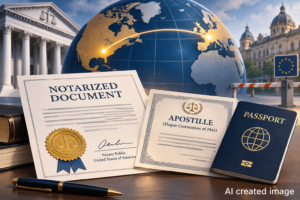 may nevertheless be rejected by a foreign authority. The problem is not necessarily a defect in the notarization or authentication process. Rather, the document may fail to satisfy the legal requirements of the jurisdiction in which it is intended to be used.
International notarization illustrates a recurring challenge in cross-border transactions: legal institutions that appear equivalent may perform fundamentally different functions.
Understanding these differences is essential for lawyers and clients involved in international real-estate transactions, corporate matters, succession proceedings, and other transactions requiring documents to be executed in one country and used in another.
- Not All Notaries Perform the Same Functions
The term notary is a particularly revealing example of a legal concept that can be lost in translation.
Although the English notary, Italian notaio, French notaire, and Spanish notario share a common linguistic origin, they refer to professionals whose qualifications, authority, and responsibilities may differ substantially.
Notaries in the United States
In the United States, notaries are generally commissioned under state law to perform limited public functions, including acknowledging signatures, administering oaths, and certifying certain acts.
Their responsibilities are largely ministerial. A U.S. notary ordinarily does not examine the substantive legality of the document or determine whether the contemplated transaction complies with applicable law.
This limited role makes notarization relatively inexpensive and readily accessible.
Civil-Law Notaries
In many civil-law jurisdictions, including Italy, France, and Germany, notaries are highly qualified legal professionals who exercise public authority.
Their functions may include drafting legal instruments, verifying the parties’ identity and legal capacity, examining the legality of transactions, and ensuring compliance with applicable formal requirements.
Unlike an attorney representing one party, a civil-law notary generally exercises these functions impartially.
An important distinction exists between two types of notarial instruments:
- Authenticated private instruments: Documents prepared or adopted by private parties whose signatures are authenticated by a notary or another authorized official.
- Authentic instruments (public instruments): Documents formally received or drawn up by a notary or another authorized public official in accordance with prescribed legal requirements.
The difference can have substantial legal consequences.
For example, under Italian law, Article 2699 of the Civil Code defines the atto pubblico (public instrument), while Article 2700 governs its special evidentiary force.
An authentic instrument may enjoy heightened evidentiary authority concerning the facts formally attested by the notary, including the parties’ appearance and declarations. This does not necessarily establish the substantive truth of every statement made by the parties.
Certain authentic instruments may also be directly enforceable without first obtaining an ordinary judgment establishing the underlying obligation.
An authenticated private instrument, governed in relevant part by Articles 2702 and 2703 of the Italian Civil Code, has different evidentiary characteristics.
These distinctions matter because a U.S. notary generally cannot create the equivalent of a civil-law authentic instrument.
Consequently, a document properly notarized in the United States may not satisfy the requirements of a transaction abroad.
- The Apostille Convention: Authentication Is Not Legal Validity
The Hague Convention of October 5, 1961, Abolishing the Requirement of Legalisation for Foreign Public Documents, substantially simplified the international authentication of public documents.
For qualifying documents between jurisdictions where the Convention applies, an apostille replaces the traditional process of diplomatic or consular legalization.
Under Articles 3–5 of the Convention, an apostille certifies the authenticity of the signature, the capacity in which the signatory acted, and, where appropriate, the identity of the seal or stamp appearing on the document.
However, an apostille does not establish the substantive validity of the underlying document or guarantee its acceptance in the receiving jurisdiction.
For example, an apostilled power of attorney may be unquestionably authentic but still fail to confer the authority necessary to complete a foreign real-estate transaction.
Similarly, an apostilled judicial order establishes its official origin without necessarily establishing that the order will be recognized or enforced abroad.
The Convention simplifies authentication. It does not harmonize the substantive laws or documentary requirements of contracting states.
Where the Convention does not apply, traditional consular legalization may remain necessary. That process can involve successive certifications by state, federal, and consular authorities, depending on the document and destination country.
Yet legalization, like an apostille, concerns the authentication of official signatures and seals, not the legal effectiveness of the underlying instrument.
- Powers of Attorney and Foreign Real-Estate Transactions
Powers of attorney provide a useful illustration of the difficulties that can arise when documents cross borders.
Consider an American purchaser acquiring real property in Italy who cannot attend the closing.
The purchaser executes a power of attorney before a U.S. notary, obtains an apostille, arranges for a translation, and sends the document to Italy.
Nevertheless, the Italian notary may determine that the instrument does not satisfy the applicable formal requirements.
The problem is not necessarily that the power of attorney was improperly notarized. Rather, the form of the instrument may be insufficient for the transaction the representative is authorized to perform.
Under Article 1392 of the Italian Civil Code, a power of attorney must comply with the form prescribed for the contract that the representative is authorized to conclude.
Accordingly, the form required for the power of attorney may depend on the form of the underlying transaction.
Is an Authentic Instrument Always Necessary?
An important distinction exists between the form legally required for a transaction and the form customarily employed by local notaries.
Although certain transactions must be completed through authentic instruments, others may be legally concluded through authenticated private instruments.
Where an authenticated private instrument is sufficient, it may be possible to structure the transaction in a manner that permits the corresponding power of attorney to be executed in the United States.
Private international law may also offer solutions.
For example, Article 60(2) of Italian Law No. 218/1995 provides that a power of attorney is formally valid when it satisfies the formal requirements of the law governing its substance or the law of the place where it was granted.
This provision may permit recognition of an instrument executed abroad even when it differs from the form ordinarily used in Italy.
Its application nevertheless requires careful consideration of the governing law, the representative’s substantive authority, and the requirements of the receiving institution.
Where an authentic instrument is legally indispensable, execution before a competent consular officer or civil-law notary may be necessary.
The essential point is that these questions should be resolved before execution, rather than after a document has been rejected at closing.
- Foreign Documents Used in the United States: Are We Asking for Too Much?
Cross-border notarization difficulties also arise when documents executed abroad are intended for use in the United States.
American lawyers and institutions sometimes request notarized foreign affidavits, corporate documents, or powers of attorney without appreciating the burdens associated with obtaining notarization in a civil-law jurisdiction.
In the United States, notarization may require only a brief appointment and a modest fee.
In a civil-law country, however, the same request may involve a specialized legal professional, advance scheduling, supporting documentation, substantive review, and considerably greater expense.
Moreover, a foreign notary may be unwilling to authenticate a document drafted under American law if its content is unfamiliar or inconsistent with the notary’s professional obligations.
Before requiring foreign notarization, it is therefore important to determine whether notarization is legally necessary or whether another acceptable method of establishing authenticity would suffice.
An unnecessary notarization requirement can create delays and costs without providing any corresponding legal benefit.
- Foreign Judicial Orders: Authentication Does Not Establish Recognition
Similar issues arise when American judicial documents are presented to foreign authorities.
Consider a U.S. probate order concerning an estate that includes real property in a civil-law jurisdiction.
The order may be properly authenticated through an apostille. Nevertheless, the foreign notary or land-registration authority may question whether it establishes ownership of the property or authorizes the proposed transfer.
The issue is not whether the American order is genuine, but whether the receiving legal system recognizes the rights or legal effects established by that order.
The foreign authority may need to examine applicable succession law, property law, and private international law.
In some circumstances, an independent legal opinion explaining the effect of the American proceedings may assist the foreign notary in evaluating the document.
Such an opinion, however, does not necessarily bind the receiving authority.
This example reinforces the fundamental distinction between authenticating a foreign document and recognizing its substantive legal consequences.
- Electronic Notarization, Remote Online Notarization, and e-Apostilles
Technological developments have introduced new possibilities for executing and authenticating documents across borders.
However, they have not eliminated the differences between national legal systems.
Electronic Notarization and Remote Online Notarization
Electronic notarization and remote online notarization (RON) are distinct concepts.
Electronic notarization generally concerns the electronic form of the document and notarial certificate, while remote online notarization concerns the signer’s appearance before the notary through audiovisual technology.
In the United States, RON may be authorized under applicable state law, subject to specific requirements concerning identity verification, technology, and recordkeeping.
Nevertheless, a remote notarization validly performed under U.S. law may not satisfy the requirements of the foreign jurisdiction where the document will be used.
For example, the receiving jurisdiction may require physical appearance before a particular public official or may not accept the electronic form of the instrument.
The location of the signer, notary, and technology provider may also raise jurisdictional questions.
Electronic Apostilles
The Hague Conference’s Electronic Apostille Programme (e-APP) supports the issuance of electronic apostilles and the use of electronic registers.
An e-Apostille performs the same legal function as a traditional paper apostille.
A valid e-Apostille cannot be rejected solely because it was issued electronically. Nevertheless, practical difficulties may arise in verifying electronic signatures or certificates, particularly when receiving institutions are unfamiliar with the technology.
Printing an e-Apostille may also interfere with the verification of electronic authentication features.
Most importantly, electronic authentication does not establish the substantive validity of the underlying instrument.
Technology can simplify the authentication process, but it cannot cure a defect in the legal form of a document.
- A Practical Framework for International Notarization
Before arranging for the execution of a document intended for use abroad, four questions should be addressed:
- Authority: Who is authorized to execute, receive, or certify the instrument in the relevant jurisdiction?
- Form: What form is required under the applicable substantive law or private international law?
- Authentication: Is an apostille, consular legalization, or another authentication procedure necessary?
- Acceptance: Will the receiving authority accept the instrument for its intended legal purpose?
An apostille ordinarily addresses the third question, not the other three.
Effective planning also requires identifying the appropriate foreign professional, obtaining an acceptable form of the document, confirming translation requirements, and allowing sufficient time for execution and authentication.
The objective is not merely to obtain a notarized document. It is to obtain an instrument that will accomplish its intended legal purpose.
Conclusion
International notarization demonstrates how procedures that appear straightforward in domestic practice can become complex when legal systems intersect.
The differences between U.S. and civil-law notaries can affect the required form of documents, their evidentiary value, their enforceability, and their acceptance abroad.
Apostilles, consular legalization, and digital authentication technologies facilitate the circulation of documents across borders, but they do not eliminate differences in substantive law.
Understanding these distinctions—and identifying potential obstacles before execution—can prevent unnecessary delays, additional costs, and unsuccessful transactions.
The decisive question is not simply whether a document has been properly notarized, but whether it will be legally effective where it is intended to be used.
Related Article
The legal complexities of international notarization also raise important questions concerning lawyers’ professional responsibilities, particularly competence, diligence, communication, confidentiality, and supervision.
For an examination of these issues, see Ethical Duties in Cross-Border Transactions: The Challenges of International Notarization.
Francesca Giannoni-Crystal is a partner at Crystal & Giannoni-Crystal, LLC. This article is based on her November 3, 2026 CLE presentation, “Ethical Duties and Practical Issues in Notarization for International Transactions,” and related scholarship coauthored with Professor Nathan M. Crystal.